



A fitting or valve can have the right size and pressure rating, yet still be the wrong choice for the application.
Proper fluid system component selection means looking at the complete operating environment. Temperature, media compatibility, application conditions, pressure, end connections, and other requirements can all influence how well a component performs once it is installed.
That is where STAMPED can help.
STAMPED is a widely used industry method for gathering important application information before selecting fluid system components. It gives engineers, maintenance professionals, and technical teams a simple framework for asking the right questions before specifying fittings, valves, hose fittings, and other components.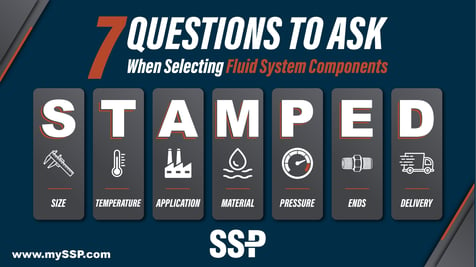
STAMPED stands for:
S - Size
T - Temperature
A - Application
M - Material
P - Pressure
E - Ends
D - Delivery
S - Size: What size does the application require?
Start with the dimensions required by the system.
For fittings, that may include tube or pipe size, thread size, or connection dimensions. For valves, port size and flow requirements may also come into play.
Choosing the correct size helps support proper flow, fit, and installation while reducing the chance of unnecessary restrictions or connection issues.
T - Temperature: What temperatures will the component experience?
Consider both the temperature of the media flowing through the system and the ambient temperature surrounding the component.
Different metals, seals, seats, packing materials, and other components have different temperature limitations. Excessive heat or cold can affect sealing performance, material properties, and service life.
Temperature should always be evaluated alongside pressure and media compatibility rather than treated as a standalone specification.
A - Application: How and where will the component be used?
The application provides context for nearly every other STAMPED factor.
Will the component be exposed to vibration, repeated cycling, corrosive environments, outdoor conditions, or tight installation spaces? Does the valve need to isolate flow, regulate it, prevent backflow, relieve pressure, or perform another specific function?
Understanding what the component actually needs to do helps narrow down the fitting or valve design that best suits the system.
M - Material: What media will flow through the system?
Media compatibility is also an important consideration in component selection.
The media being transferred must be compatible with the body material, seals, seats, packing, tubing, fittings, and other wetted components in the system.
A fitting or valve may meet the required size and pressure rating but still be unsuitable if its materials are not compatible with the liquid, gas, or other media flowing through it.
When evaluating compatibility, consider the specific media, concentration, operating temperature, and other system conditions.
P - Pressure: What pressure will the system experience?
Identify the system’s normal working pressure, but do not stop there.
Pressure spikes, surges, vacuum conditions, cycling, and relief or cracking pressure requirements can all influence component selection.
Valves and fittings should be rated appropriately for the full range of conditions they may encounter. Looking beyond normal operating pressure helps create a more complete picture of what the application actually demands.
E - Ends: What connections are required?
Even the right component needs to connect properly to the rest of the system.
Consider the connection type, size, thread, fitting style, material, and orientation required at each end.
Depending on the application, that could include tube fittings, NPT, SAE, BSP, AN/JIC, ORFS, weld connections, hose fittings, or other connection types.
Choosing the correct ends can simplify installation and reduce the need for extra adapters or unnecessary connection points.
D - Delivery: What additional requirements need to be met?
Delivery can mean more than simply asking when the component is needed.
Quantity, lead time, testing, inspection, quality documentation, packaging, certifications, and other application-specific requirements may all need to be considered.
Discussing these details early helps make sure the selected components meet both the technical and logistical needs of the application.
Why Is STAMPED Useful for Fluid System Selection?
The value of STAMPED is its simplicity. It encourages engineers and maintenance teams to look at the complete application, rather than selecting a component based on only one or two specifications.
Size and pressure may be obvious starting points, but temperature, application conditions, media compatibility, connection requirements, and delivery needs can be just as important.
SSP manufactures a wide range of tube fittings, pipe fittings, weld fittings, hose fittings, and instrumentation valves for industrial fluid systems. Working through the STAMPED factors can help organize the information needed when evaluating which components are best suited for an application.
Before specifying your next fluid system component, remember one word:
STAMPED.
Seven questions can help move component selection beyond simply finding something that fits, toward choosing a solution better suited for the actual operating conditions.